
Basics
How long does a Whir mixer session take?
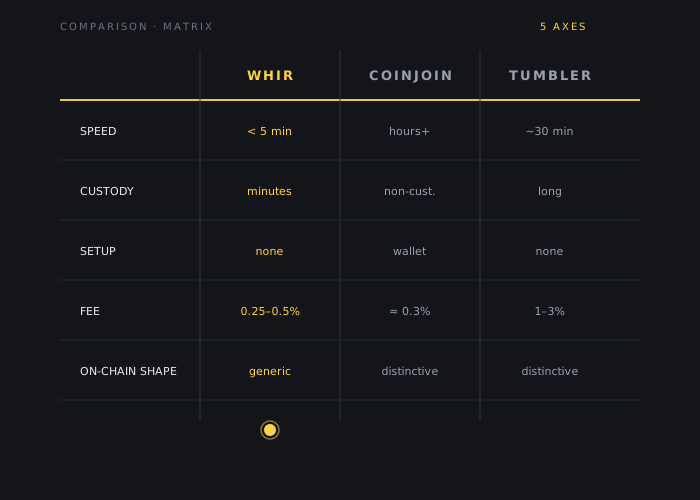
Most mixes complete in under five minutes once the deposit confirms. The Lightning routing itself takes seconds; the on-chain confirmation wait is the slow step.
Is the Whir Bitcoin mixer custodial?
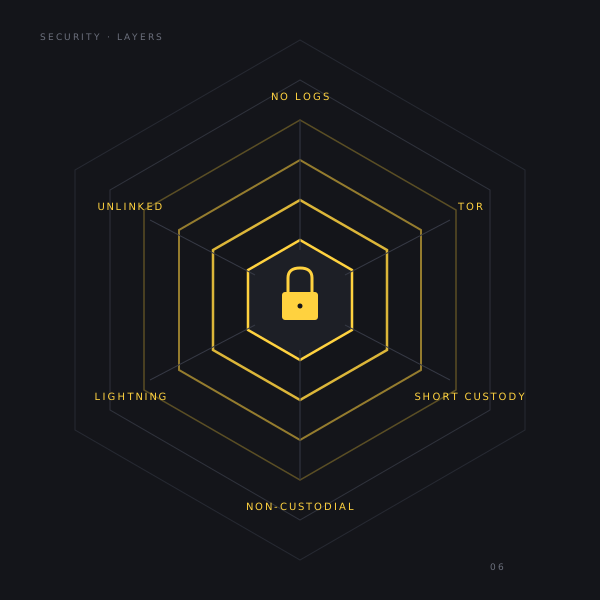
It is short-window custodial. Funds are under operator control only for the few minutes between deposit confirmation and Lightning payout, not for days like a legacy BTC tumbler or older Bitcoin blender.
Does the Whir mixer keep logs?
No historical log database is retained. Session records exist in memory for the mix lifetime and are dropped at payout. There is nothing for a subpoena to reach beyond the active session window.
Do I need to register?
No. There is no account system. Each mix is a single session with a freshly generated one-time deposit address. No email, no password, no recovery flow.
Cost and limits
How much does the Whir mixer cost?
A 0.5% base service fee, dropping to 0.25% for mixes above one BTC. A small Lightning routing fee is paid to the network on top. See the fees page for tier details and worked examples.
What are the minimum and maximum amounts?
Practical minimum is around 0.001 BTC, below which on-chain fees start to dominate the cost. There is no hard maximum, though very large mixes are split across multiple Lightning paths internally to maintain a clean payout shape.
Can I split the payout to multiple addresses?
Yes. At session start, the user can provide several payout addresses with custom split ratios. Each output is settled from the operator's UTXO set with no shared ancestry to the deposit.
Privacy and network
Is Tor required to use the Whir mixer?
Tor is recommended but not strictly required. The BTC mixer interface is reachable both on the clear net and through a Tor hidden service. Using Tor removes the IP-level link between user and operator at the network layer.
What does the payout look like on-chain?
A generic Bitcoin payment — a handful of inputs and one or a few outputs, with no distinctive CoinJoin shape. Passive observers cannot tell from the transaction alone that a privacy tool was used.
What threats does the Whir mixer not protect against?
No Bitcoin mixer — legit, trusted, or otherwise — can remove information already published off-chain. KYC records at a regulated exchange, or wallet addresses you have publicly linked to your identity, stay where they are. Privacy starts at the mix, not before it.
Practical edge cases
What if the deposit never arrives?
If the deposit address never receives a confirmed transaction within the session timeout, the session expires and is dropped from memory. Nothing is owed; no record persists.
Is there a letter of guarantee?
Yes. At session start the Whir BTC mixer issues a signed letter of guarantee, committing the operator to the quoted payout terms. It is verifiable against a published public key, so the commitment is checkable even after the session ends.
Still have questions? The technical walkthrough covers the routing flow in detail, and the security page covers the threat model.